[ ./recipes/cakes/croissants.md ]
★ FRENCH · CAKES
Croissants.
SERVES
8
TOTAL
1440m
ACTIVE
120m
LVL
HARD
COOKED
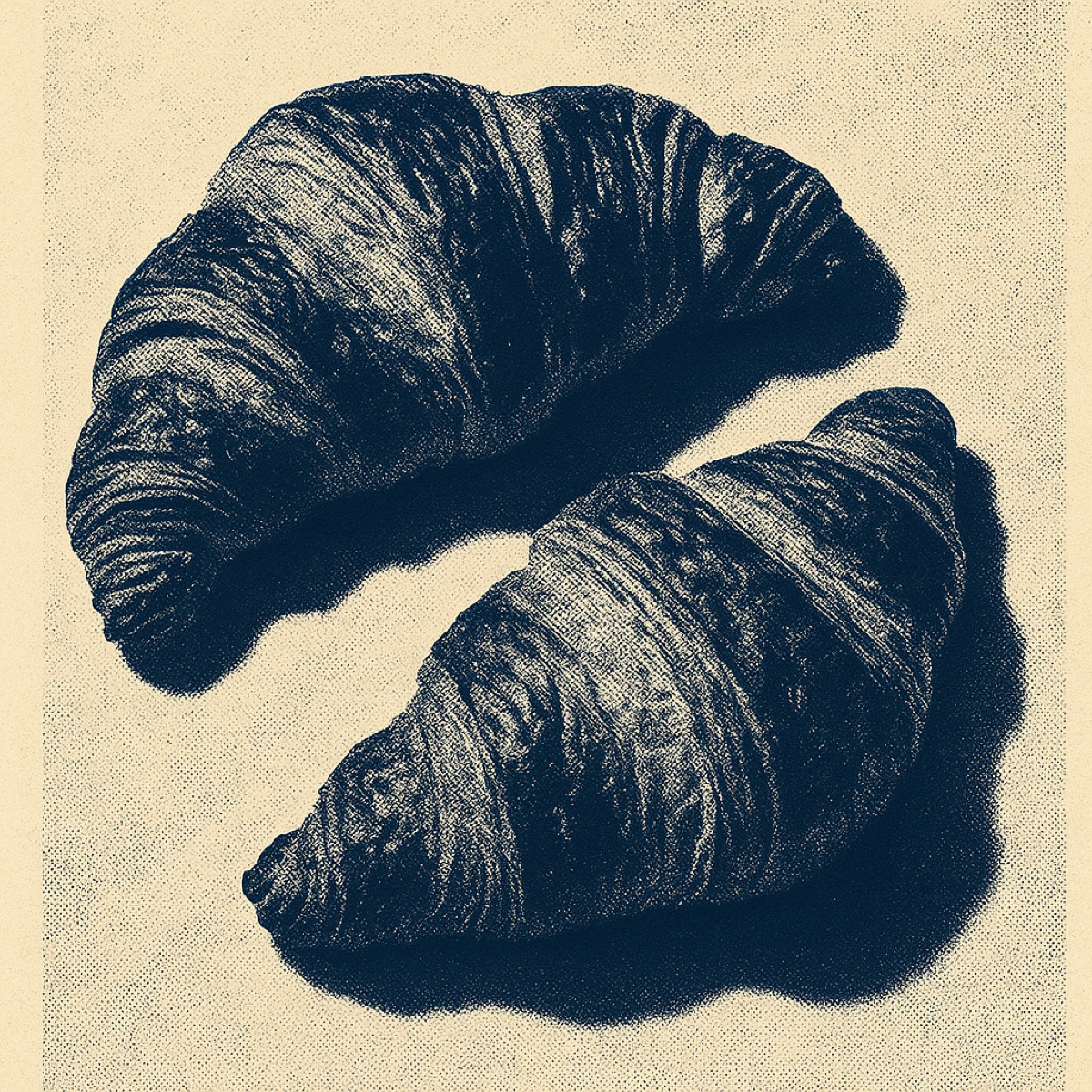
// SUMMARY
Claire Saffitz's meticulously developed croissant recipe — a two-day process that yields perfectly laminated, shatteringly flaky pastries with an airy, honeycomb interior. The key is careful temperature control throughout lamination: keeping butter and dough at matching firmness, precise rolling, and patient proofing in a humid environment.
// INGREDIENTS
| 605 | g | all-purpose or bread flour, plus more for dusting |
| 66 | g | granulated sugar |
| 12 | g | kosher salt (1 tbsp + ½ tsp) |
| 7 | g | active dry yeast (2¼ tsp) |
| 214 | g | water, room temperature |
| 120 | g | whole milk, room temperature |
| 57 | g | unsalted butter, cut into 1 cm pieces, chilled |
| 340 | g | unsalted European-style butter (3 sticks), chilled |
| 1 | large egg yolk | |
| 1 | tbsp | heavy cream |
// METHOD
- 01
**Mix the détrempe**: Combine flour, sugar, salt, and yeast in a stand mixer bowl fitted with a dough hook. Make a well, pour in water and milk. Mix on low speed until a tight, smooth dough forms around the hook, about 5 minutes. Remove hook, cover bowl with a damp towel, and let rest 10 minutes.
- 02
**Add butter**: Reattach dough hook, mix on medium-low. Add butter pieces all at once, continue mixing (scraping bowl once or twice) until dough forms a very smooth, stretchy ball that is not sticky, 8–10 minutes.
- 03
**First rise & chill**: Form dough into a ball, place seam-side down on a lightly floured surface. Cut two deep perpendicular slashes forming a "+". Place slashed-side up in the mixing bowl, cover with plastic wrap, and let rise at room temperature until about 1½ times its size, 45 minutes to 1 hour. Transfer to the refrigerator and chill 4–12 hours.
- 04
**Make the butter block**: Place the butter sticks side by side in the center of a large sheet of parchment paper. Fold all four sides over the butter. Flip the packet and beat the cold butter with a rolling pin into a flat, scant 1 cm thick layer. Unwrap, replace parchment if needed, and refold into a neat 20 cm square. Flip and roll to flatten butter into an even layer filling the entire packet. Refrigerate.
- 05
**Prepare the dough**: Remove dough from fridge (it will have doubled). Deflate with the heel of your hand. Stretch the four points from the slashes outward, flattening into a rough 20 cm square. Wrap tightly in plastic, maintaining squared-off edges, and roll over the plastic to form an even 20 cm square. Freeze 20 minutes.
- 06
**Enclose the butter**: Remove butter from fridge and dough from freezer. Roll dough on a lightly floured surface to 40 cm long, maintaining 20 cm width. Brush off excess flour. Unwrap butter and invert the block onto the center of the dough. Fold the overhanging dough sides over the butter to meet in the center, pinching all seams shut. Rotate 90° so the seam runs vertically.
- 07
**First turn (double/book turn)**: Beat the dough lightly with the rolling pin to lengthen, then roll out lengthwise into a 60 cm long, 6 mm thick slab. Trim the short ends to square off. Fold one short side to the midline, then the other (leaving a 3 mm gap where they meet), then fold the whole slab in half along that gap — like closing a book. This quadruples the butter layers. Wrap in plastic, freeze 15 minutes, then refrigerate 1 hour.
- 08
**Second turn (simple/letter turn)**: Let dough sit at room temperature 5 minutes. Roll out into a long, narrow slab about 1 cm thick. Fold in thirds like a letter (top third down, bottom third up). This triples the layers. Wrap, freeze 15 minutes, then refrigerate 1 hour.
- 09
**Final roll & overnight chill**: Let dough sit at room temperature 5 minutes. Roll out to a 35×43 cm slab. Brush off excess flour, wrap tightly in plastic, slide onto a baking sheet. Freeze 20 minutes, then chill overnight (8–12 hours).
- 10
**Set up proofing environment**: About 4½ hours before serving, arrange oven racks in upper and lower thirds. Bring a skillet of water to a simmer, transfer to the oven floor, and close the door (the steam creates ideal humidity for proofing).
- 11
**Cut and shape**: Let dough sit at room temperature 5 minutes. Unwrap and roll to 35×43 cm if needed. Brush off all excess flour. Trim to exactly 40 cm long, then cut into four 10×35 cm rectangles. Slice each rectangle diagonally corner to corner, making 8 long triangles. Trim the short side of each at a slight angle so both long sides are equal.
- 12
**Roll the croissants**: Working one triangle at a time, gently tug the base corners outward to widen to about 7 cm, then stretch the triangle lengthwise from the midpoint to the tip. Starting at the base, snugly roll up toward the point, keeping it centered. Place point-side down on a parchment-lined baking sheet, 4 per sheet. Loosely cover with plastic wrap.
- 13
**Proof**: Place sheets in the steamy oven (should be 21–24°C, humid but not hot). Proof until doubled, extremely puffy, and jiggling when the sheet is gently shaken, 2–2½ hours. Do not touch or poke — they are very delicate.
- 14
**Chill & preheat**: Remove sheets from oven, uncover, and refrigerate 20 minutes. Remove the skillet and preheat oven to 190°C.
- 15
**Egg wash**: Whisk egg yolk and cream until streak-free. Gently brush the smooth surfaces of each croissant, avoiding the cut sides with exposed layers.
- 16
**Bake**: Bake 20 minutes, then rotate sheets and swap racks. Continue baking until deeply browned, another 10–15 minutes. Let cool completely on the baking sheets.
// NOTES
- — Temperature is everything: Butter and dough must be at matching firmness during lamination. If the butter is too cold it will crack; too warm and it melts into the dough.
- — Don't rush proofing: Under-proofed croissants will be dense rather than light and airy. They should visibly jiggle when the pan is shaken.
- — Best fresh: Croissants are best within an hour or two of baking. To revive, warm in a 175°C oven for 5–8 minutes. Store wrapped airtight at room temperature.
// SOURCE
- Claire Saffitz / NYT Cooking
- ↗ Croissants - Claire Saffitz (NYT Cooking)
- ↗ Technique video (NYT Cooking)